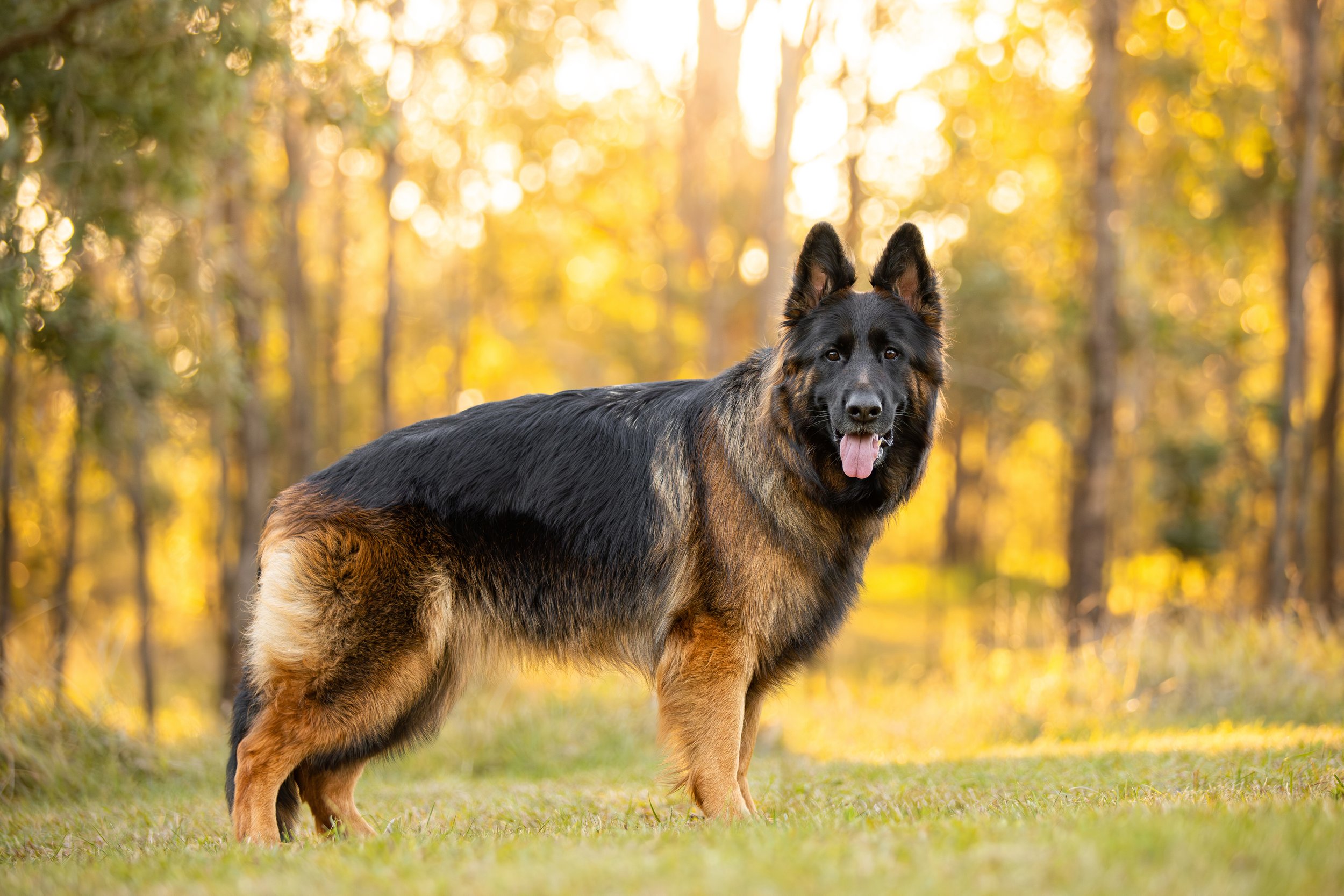
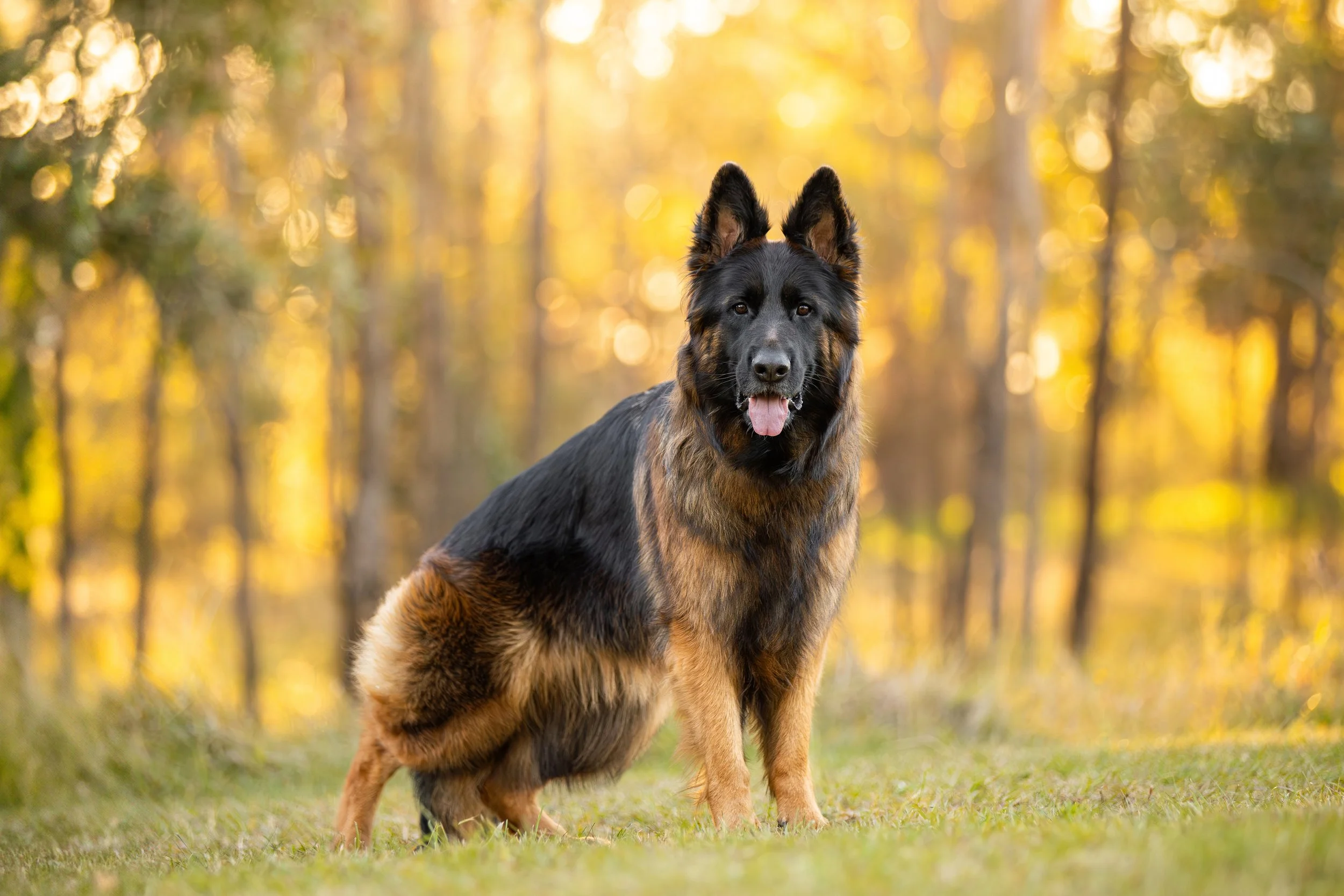
Purpose, Reflection, and the German Shepherd Dog - an eternal debate
I’m addressing this because I get asked a lot whether my dogs are straight backed, slope backed, working line or show line German Shepherds. I can acknowledge that this distinction exists, and I understand why people use the terms, but I do not wish to sink myself into the heart of that debate or mentality.
Ultimately, regardless of whether you pair two dogs typically labelled one way, two labelled another, or a combination of the two, somewhere in those genetics sits a working dog. That foundation does not disappear simply because we have chosen to categorise dogs differently over time for our own human understanding because that is where someone’s breeding programme has taken them. Oh and this isn’t just the general public, people who term themselves “breeders” use this same terminology to deter people from buying from one camp or the other!
When I respond with, “I don’t subscribe to the show line versus working line debate. My view is that if German Shepherds are being bred for breed preservation, with genuine intent to preserve and improve the breed, they should retain the fundamental characteristics the German Shepherd Dog was originally developed for,” I am often met with confusion or dismissal.
Sometimes that dismissal comes in the form of, “What would you know? You’ve only been in the breed a couple of years.” Or “What would you know your dogs don’t work, you just train them, they don’t even have titles” Or “What would you know you have show shepherds” What all of that overlooks is not how long I have been here or what people see me doing with my dogs but how I have approached being here.
I came into this breed without a pre-formed ideology and without pressure to align myself with a particular camp. More importantly, I came into it prepared to reflect. Not only on the dogs in front of me, but on my own thinking. I have spent time questioning why I hold certain views or do certain things, what evidence supports them, and where they may need to be refined. That process of self reflection has mattered more to me than inheriting the dominant opinions of whichever space I happened to enter first.
The German Shepherd Dog was developed for purpose. From its earliest foundations, it was expected to be physically capable, mentally stable, and able to work with endurance while remaining clear headed and trainable. These are not abstract ideals. They are traits rooted in functional anatomy, movement efficiency, and behavioural resilience.
Structure, temperament, and working ability were never meant to exist independently. Conformation exists to support function. Drive exists to support work. Temperament exists to allow the dog to cope with pressure, environment, and responsibility. When one of these elements is prioritised to the exclusion of the others, something fundamental is lost.
This is where much of the modern confusion comes from. Over time, emphasis has shifted. Some breeding programs have focused heavily on appearance, others on performance, and language has reinforced the idea that these are separate “types” of dogs rather than different expressions of the same breed. The German Shepherd was never intended to be a breed of extremes. Balance was always the point.
I am not suggesting that anything I have produced so far is anywhere near perfect, and I do not believe perfection exists in breeding. Even when we believe we have selected the best possible pairing, no dog is flawless and no outcome is guaranteed. What I am doing is trying, and then reflecting honestly on the results.
From my most recent litter of six, three have demonstrated early working ability. One has “working ability” but, at this stage of development, does not yet show the level of temperament stability I would ideally like to see. Two are better suited to homes where a calmer, more laid back nature is not only appropriate but valuable, while still retaining the instinct to recognise where they are needed (kicker this still means they work, just there drive is different). One of those puppies will hopefully oneday head into therapy work, a role that requires discernment, sensitivity, and stability just as much as instinct. That is not a dilution of purpose, but another expression of it.
My first litter consisted of only two puppies, and even within that small sample the differences were instructive. One is incredibly balanced - calm, considerate, and thoughtful, while still retaining the capacity to work within certain models. The other does not switch off easily. If there is a job to be done, it occupies his mind fully. That intensity is not disorder. He is clear headed, understands the work I ask of him, and can discern between appropriate and inappropriate behaviour. As he matures, I believe he will continue to uphold the breed’s philosophies, and will develop an off switch even if his expression of these things looks different to a Labrador, or a Great Dane, or a Chihuahua.
It is also important to acknowledge that what presents on the surface does not always tell the full story.
One of the most common misunderstandings I see relates to structure, particularly the idea of a “sloped back.” In most cases, what people are reacting to is not the dog’s spine at all. From a veterinary anatomy perspective, the canine spine, including that of the German Shepherd, is designed to be firm, straight, and stable. This is well documented in standard veterinary texts such as Miller’s Anatomy of the Dog and Textbook of Veterinary Anatomy, which clearly distinguish spinal structure from limb function and posture.
What is often described as “slope” is actually the visual effect created by limb angulation, limb length, musculature, and foot placement, particularly when a dog is positioned to demonstrate reach and drive. When a anatomically correct German Shepherd is stacked or posed correctly, the hind limb is extended and the forelimbs are placed to allow the dog to express balance and efficiency. This changes how the body weight falls and can create the appearance of a downward line from wither to rear, but that line is not the spines default permanent “slope” it is how they are positioned.
When the same dog is four point stacked or standing naturally, the back presents as straight and level. The structure has not changed; only the presentation has.
Veterinary gait and biomechanics research supports this distinction. Studies of German Shepherd movement show that during efficient gait, the forelimbs reach forward and the hindquarters provide drive, allowing the dog to cover ground with minimal effort. These studies demonstrate that what we see in a posed outline often reflects potential for movement, not structural deformity of the back.
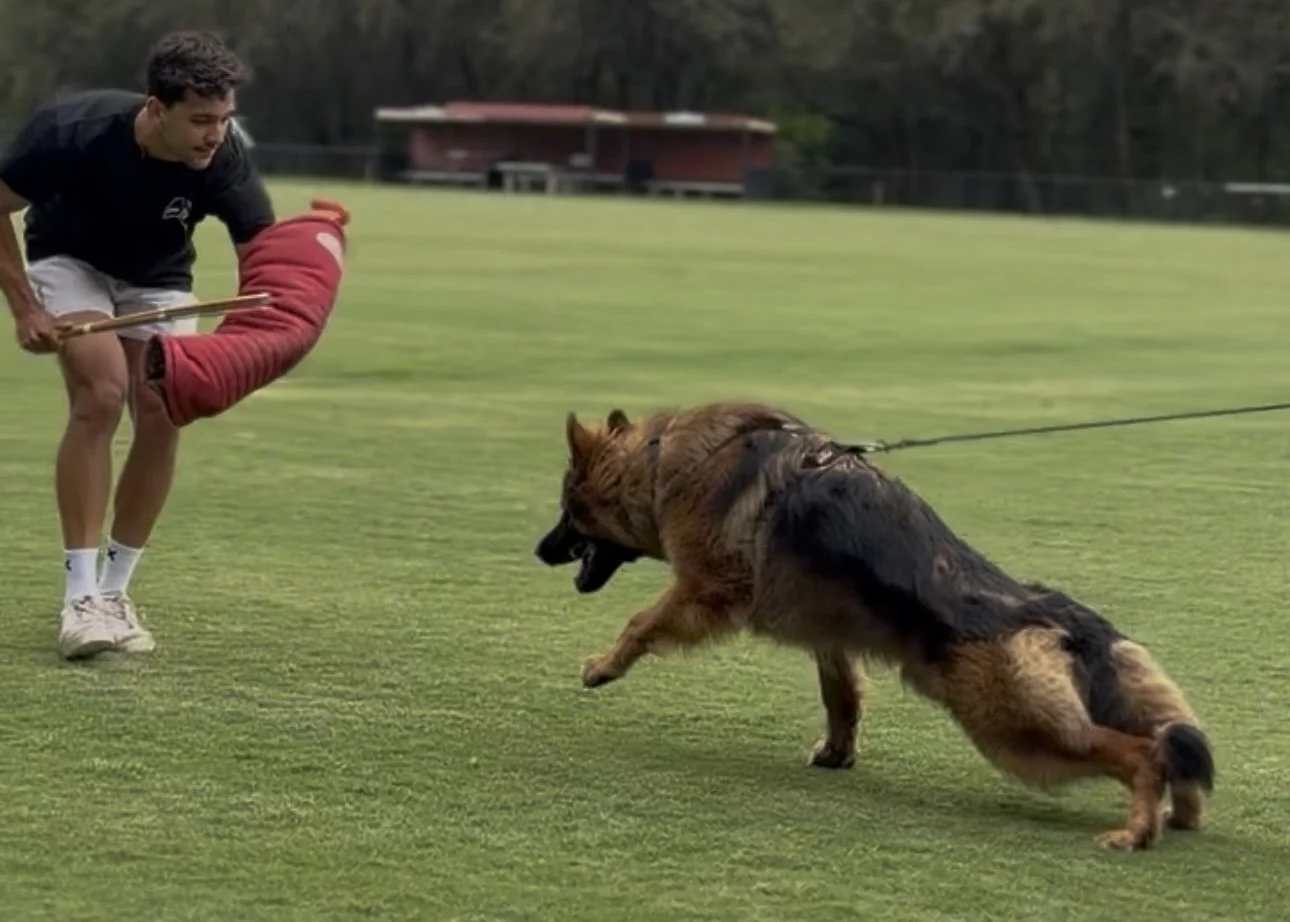
What is often overlooked is that the outline people criticise is closely aligned with how a dog appears when it is actually working or moving efficiently. In motion, the body naturally angles forward as the forehand reaches and the hindquarters drive, while the topline remains firm and stable. When I present my dog, I am demonstrating their capacity to cover ground from a stationary position , their drive, and efficiency once movement is initiated, not manipulating their spine.
This is why structure must always be assessed in motion and in context. Function cannot be accurately judged from a single still image or stacked photograph. This principle is well established.
When I first turned up to training with Bane as a four month old puppy, I told my trainer, “I breed show line German Shepherds.” At the time, that reflected where my thinking sat then. While I was looking for a dog with more drive and one that improved on some of Maya’s conformational faults, my intent was still somewhat skewed. It took that first litter, and the reflection that followed, to truly cement what I was trying to achieve.
My trainer was honest with me. He wasn’t sure what I would achieve with Bane. I told him I didn’t mind what I achieved, I just knew Bane was capable of more than the stereotype attached to his breeding (“show line”).
Looking back now, we can laugh about those early sessions. I saw a dog with significant capability who needed that drive outlet. The trainer saw someone who was perhaps naïve and expecting more than the dog was capable of. What we have both come to understand is that neither of us was entirely right or wrong.
What I was really trying to do was enjoy my dog and allow him to fulfil his natural instincts. What the trainer came to see was that, irrespective of stereotypes placed on dogs based on their background, with the right guidance they are capable of developing far more than they are often given credit for.
That does not mean all dogs can or should do the same things. Even within the same litter, dogs will differ in drive, resilience, and suitability for particular roles. But every one of them still preserves a version of the breed’s original purpose, expressed differently.
This is why it matters to talk to your breeder. Why it matters to trust that they may know the dogs they produce better than a snapshot or a comment thread ever could. And why sometimes the most responsible answer a breeder can give is that there is not a puppy in that litter for you, but that they are happy to refer you to someone who may have what you are actually looking for or in a future litter may have what you are looking for.
That, to me, is what breeding with intent looks like. It is not about being right. It is not about fitting into a category.
It is about respecting where the breed came from, being honest about what stands in front of you, and having the humility to keep learning as you go. It is also about setting your dogs up for success wherever they may end up!
When you are looking for a breeder, STOP asking if their dogs have a “sloped” or “straight” back. Honestly, it makes you look uneducated.
And while we’re at it, stop asking if a dog is “working line” or “show line” like it’s black and white. There are plenty of breeders, myself included, who breed with the intention of preserving the whole dog, not boxing it into human labels.
What you should be asking your breeder is:
• Have your dogs undergone appropriate health testing? Hips and elbows, and what are the scores?
• Have they had heart and eye clearances?
• Have they been assessed as conformationally sound?
• What is the purpose behind this breeding? What are you trying to produce or improve?
• What is the temperament of your dogs? Not just the parents, but what are you consistently producing?
• Can I see photos and videos of the sire and dam, and dogs from previous litters?
• How are the puppies raised? What exposure, socialisation, and early development protocols are in place?
• What support do you offer after the puppy goes home?
• What does your contract look like?
• How do you match puppies to homes? Or are buyers choosing there puppy?
• What are the energy levels, drives, and realistic expectations for this pairing?
• What health guarantees or transparency do you provide if something does go wrong?
Find someone you trust, someone who understands the breed, and seek advice.
I don’t claim to know even half of what there is to know about this breed, but if you ever have a question, message me. I’m not here to tell you not to buy from one breeder or another. I actively encourage people to look around. I am a small, limited litter breeder, and I am not always going to have what you’re looking for.
If you’ve found another breeder and you’re unsure, send me what they’ve provided. Health results, answers, anything. I’m more than happy to help explain it, point you in the right direction, or even go and find answers from people far more experienced than me.
And one more thing… say it with me…
STOP BUYING FROM BACKYARD BREEDERS.
That is where most of your problems start. No health testing, no purpose, no accountability, just breeding for profit with no regard for what they are producing.
If you would like to better understand how the German Shepherd Dog is meant to be constructed and presented, I encourage you to take a look at the breed standard, the document that outlines the structure, movement, and overall characteristics the breed was originally developed to embody. You can find the extended breed standard here: https://www.gsdcouncilaustralia.org/gsdcacontent/uploads/2015/03/GSD-Extended-Breed-Standard2015.pdf
LASTLY before the respective camps come for me! I DONT WANT TO HEAR IT, if you have nothing nice to say, keep it to yourself!